醫療新知
哪些食物、保健品真的護心?
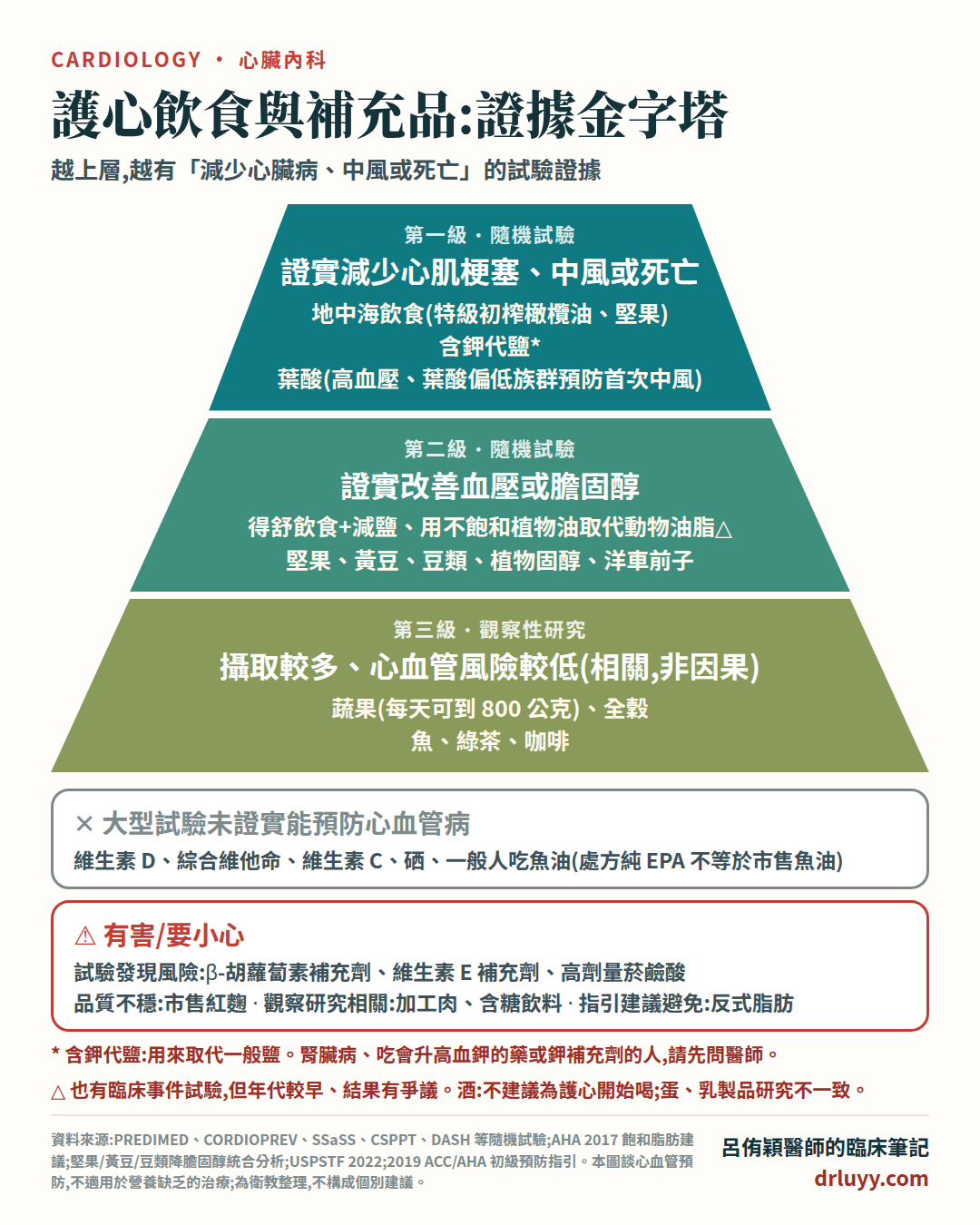
【醫療新知】哪些食物、保健品真的護心?
━━━━━━━━━━━━━━━━━━━━━━━
「醫師,我每天吃魚油、Q10、維他命、紅麴,這樣心臟有顧到嗎?」門診常聽到這句話。網路上「護心食物」「護心保健品」清單一大堆,但很少有人告訴你:這些說法背後的證據,強度差非常多。
這篇把國際上最重要的隨機試驗、統合分析和指引整理成一張「證據金字塔」,告訴你哪些真的有證據、哪些只是「看起來相關」、哪些花錢沒效,甚至有害——每個重點都標明出處。
━━━━━━━━━━━━━━━━━━━━━━━
▎先講結論
① 真正有隨機試驗證明能「減少心肌梗塞、中風或死亡」的,少得可憐:地中海飲食、含鉀代鹽,以及特定族群補充葉酸預防中風。
② 最值得花力氣的是「整體飲食型態」(地中海飲食、得舒飲食、減鹽、用好油取代動物油),不是單一神奇食物或保健品。
③ 大部分保健品(維生素 D、綜合維他命、維生素 C、硒、一般人吃魚油)在大型試驗裡都沒能證實可預防心血管病。
④ 有些不建議為護心自行補充,部分族群和劑量的試驗甚至觀察到傷害:β-胡蘿蔔素補充劑、維生素 E 補充劑、高劑量菸鹼酸;市售紅麴則有品質不穩和副作用的問題。
⑤ 蔬果、全穀、魚、綠茶、咖啡這些「多吃風險較低」的說法,多半來自觀察性研究——是相關,不一定是因果,也不是越多越好。
━━━━━━━━━━━━━━━━━━━━━━━
▎先搞懂:什麼叫「證據硬」?
看健康新聞前,先記住兩個觀念:
【觀念 1】隨機試驗 vs 觀察性研究
・隨機試驗:把人隨機分成兩組,一組吃、一組不吃,再比較誰比較少生病。因為是隨機分組,兩組人原本的條件差不多,差別才比較能歸因於「吃的東西」。
・觀察性研究:只是追蹤「本來就吃比較多某種食物的人」後來怎樣。問題是,吃很多蔬果的人,往往也比較常運動、不抽菸、收入較高——所以就算他們比較少得心臟病,也不一定是蔬果的功勞。
【觀念 2】「硬指標」vs「數字變好看」
・硬指標:心肌梗塞、中風、死亡——這才是我們真正在乎的。
・替代指標:血壓、膽固醇降了。這通常是好事,但「數字變好看」不保證「真的少生病」,歷史上有不少藥物和保健品,數字改善了,結果卻沒變好。
所以金字塔的分級是:
・第一級:隨機試驗證實「減少心肌梗塞、中風或死亡」
・第二級:隨機試驗證實「改善血壓或膽固醇」
・第三級:觀察性研究,「攝取較多、風險較低」,但只是相關
━━━━━━━━━━━━━━━━━━━━━━━
▎第一級:隨機試驗證實減少心肌梗塞、中風或死亡
【地中海飲食】
・PREDIMED 試驗(西班牙 7,447 位 55–80 歲、心血管高風險但還沒發病的人):地中海飲食加特級初榨橄欖油那組,心肌梗塞、中風或心血管死亡的風險少約 31%;加堅果那組少約 28%。
・這個試驗 2013 年的原始論文因為有部分受試者(例如同住家人)沒有真正隨機分組,2018 年撤稿後重新分析、重新刊登,結論不變,但隨機性打了折扣。
・CORDIOPREV 試驗(1,002 位已有冠心病的人,追蹤 7 年):地中海飲食對比低脂飲食,心血管事件每千人年 28.1 對 37.7 次,風險少約 25–28%。但效果主要在男性,女性(175 人)看不出差別,而且是單一醫院的研究。
・里昂飲食心臟研究(心肌梗塞後的病人):改吃地中海型飲食,心因性死亡加上非致死性心肌梗塞是 14 對 44 例。
・注意:這些都是「整套飲食型態」的試驗,不是證明「多吃橄欖油或堅果」單獨就能預防。
對照一個反例:美國婦女健康倡議(WHI)讓 48,835 位停經女性以「降低總脂肪、增加蔬果和穀類」為目標調整飲食,追蹤約 8 年,冠心病、中風風險都沒有顯著降低。→ 不能只用「油吃多少」來判斷飲食護不護心。
【含鉀代鹽】
・SSaSS 試驗(中國農村 20,995 人,七成以上曾經中風):把家裡的鹽換成「75% 氯化鈉+25% 氯化鉀」的代鹽,約 5 年後,中風風險少約 14%、主要心血管事件少約 13%、死亡少約 12%。在試驗納入的族群中,沒有觀察到高血鉀相關的嚴重不良事件顯著增加——但這不代表腎功能不好的人也安全。
・重點是「取代」一般鹽,不是另外加。
・⚠ 腎臟病,或正在吃會升高血鉀的藥、鉀補充劑的人,換鹽前一定要先問醫師。SSaSS 試驗特別排除了本人或同住家人有已知嚴重腎臟病、使用保鉀利尿劑或鉀補充劑的家庭。
【葉酸(特定族群預防中風)】
・CSPPT 試驗(中國 20,702 位沒有中風或心肌梗塞病史的高血壓成人):每天都吃降血壓藥 enalapril 10 毫克,隨機比較有沒有再加葉酸 0.8 毫克,約 4.5 年首次中風從 3.4% 降到 2.7%(風險少約 21%);但心肌梗塞、死亡沒有差別。
・研究者認為好處跟這群人原本葉酸偏低有關。所以這不代表每個人都該補葉酸,葉酸本來就不缺的人未必有同樣效果,要不要補請讓醫師評估。
━━━━━━━━━━━━━━━━━━━━━━━
▎第二級:隨機試驗證實改善血壓或膽固醇
【得舒飲食+減鹽】
・得舒飲食(多蔬果、全穀、低脂乳品、少紅肉與甜食)的經典試驗:高血壓患者收縮壓平均多降 11.4 mmHg。
・再加上減鹽,效果還能疊加:高血壓患者比「一般飲食+高鹽」收縮壓低 11.5 mmHg。
・世界衛生組織建議:每天鹽少於 5 公克(鈉少於 2,000 毫克)。
【用不飽和植物油取代動物油脂】
・美國心臟協會 2017 年的建議指出,用多元不飽和植物油取代飽和脂肪的隨機試驗,心血管疾病減少約 30%,跟吃降膽固醇藥的效果差不多;但如果改用精緻澱粉或糖取代飽和脂肪,就沒有好處。
・為什麼放第二級?因為這類臨床事件試驗年代都很早、結果有爭議。例如重新挖出資料的「雪梨飲食心臟研究」(458 位冠心病男性),改用紅花籽油的那組,總死亡反而較高(17.6% 對 11.8%)。
・所以比較確定的是「降膽固醇」這件事;實務上,用橄欖油、芥花油這類不飽和植物油取代豬油、奶油是合理的,但不用迷信某一種油。注意椰子油、棕櫚油雖然是植物油,卻富含飽和脂肪。
【堅果、黃豆、豆類】
・堅果:61 個試驗的統合分析,每天一份(約 28 公克)壞膽固醇降約 4.8 mg/dL。
・黃豆蛋白:每天約 25 公克,壞膽固醇降約 4.8 mg/dL(約 3–4%)。(該分析有作者來自黃豆營養相關機構,解讀時可留意。)
・豆類(扁豆、鷹嘴豆等):26 個隨機試驗,每天約 130 公克(大約一份),壞膽固醇降約 0.17 mmol/L(約 6.6 mg/dL)。
・幅度不大,但加起來就有感,而且這些食物本身就是很好的蛋白質來源。
【植物固醇、洋車前子】
・植物固醇:每天約 2 公克,壞膽固醇降 8–10%,還能跟降膽固醇藥加乘;但目前沒有證明能減少心臟病的硬指標試驗。
・洋車前子(一種水溶性纖維):每天約 10 公克,壞膽固醇降約 0.33 mmol/L(約 13 mg/dL)。一定要配足量的水,不要乾吞;也要跟其他藥物錯開時間吃。
━━━━━━━━━━━━━━━━━━━━━━━
▎第三級:觀察性研究——攝取較多、風險較低(相關,非因果,也不是越多越好)
・蔬果:每天多吃 200 公克,冠心病風險低約 8%、中風低約 16%;一直到每天約 800 公克(蔬菜水果加起來),風險都還在下降。800 公克是研究觀察到的範圍,不是硬性目標。
・全穀:每天全穀食物每多吃約 90 公克(研究定義約 3 份),冠心病風險低約 19%。值得注意的是,白米、精緻穀類跟心血管風險幾乎沒有關聯——對吃白飯為主的台灣人,換一部分成糙米、燕麥是實際的方向。
・魚:美國心臟協會建議每週吃 1–2 次海鮮,尤其是拿來取代比較不健康的食物(例如加工肉)。
・綠茶:日本大崎研究,女性每天喝 5 杯以上,心血管死亡風險低約 31%。
・咖啡:英國生物銀行研究,每天 2–3 杯的人風險最低。
再強調一次:這些都是「相關」。吃這些東西的人,可能本來就比較健康。它們值得吃,但別把它們當成藥。
━━━━━━━━━━━━━━━━━━━━━━━
▎大型試驗未證實能預防心血管病的保健品
・維生素 D:VITAL 試驗(每天 2000 國際單位)主要心血管事件沒有減少;澳洲 D-Health 試驗(每月 6 萬國際單位)也沒有顯著減少,只在次要分析看到心肌梗塞較少。
・綜合維他命:美國醫師健康研究第二期、COSMOS 兩個大型試驗都沒有減少心血管事件。
・維生素 C:美國醫師健康研究第二期,沒有減少心血管事件。
・硒:考科藍系統性回顧,補充硒對心血管沒有好處。
・一般人吃魚油預防:VITAL(健康成人)、ASCEND(糖尿病人)兩個大型試驗,主要心血管事件都沒有顯著減少(VITAL 的心肌梗塞較少屬於次要結果)。處方級的高純度 EPA 是另一回事,不等於市售魚油,詳見本站魚油文章。
美國預防服務工作小組(USPSTF)2022 年的結論也是:大多數維生素、礦物質、綜合維他命,目前證據不足以建議拿來預防心血管病。
注意:這裡講的是「預防心血管病」。如果你本身有營養缺乏(例如缺鐵、缺維生素 D),該補還是要補,那是另一件事。
━━━━━━━━━━━━━━━━━━━━━━━
▎有害或要小心的
【試驗發現有風險】
・β-胡蘿蔔素補充劑:CARET 試驗(β-胡蘿蔔素加維生素 A),總死亡風險增加約 17%,試驗因此提前終止;在吸菸者身上還增加肺癌。美國預防服務工作小組明確建議:不要為了預防心血管病或癌症而補充。(從蔬果吃到的胡蘿蔔素不是這個問題。)
・維生素 E 補充劑:HOPE-TOO 試驗(有血管疾病或糖尿病的年長者,每天 400 國際單位)心衰竭風險增加約 13%;美國醫師健康研究第二期(男性,每兩天 400 國際單位)出血性中風風險增加約 74%。美國預防服務工作小組同樣建議:不要為了預防心血管病或癌症而補充。這不代表所有劑量、所有人都一定受害,但為了護心自己吃,是弊多於利。
・高劑量菸鹼酸:在已經吃降膽固醇藥的人身上,AIM-HIGH 試驗因為看不到好處提前終止;HPS2-THRIVE 試驗(菸鹼酸合併另一種藥)沒有減少心血管事件,卻增加糖尿病惡化、感染和出血。
【品質不穩】
・市售紅麴:紅麴裡降膽固醇的成分「紅麴菌素 K」,化學上就是降膽固醇藥 lovastatin。美國抽驗 12 款市售紅麴,每顆含量從 0.1 到 10 毫克都有,差了上百倍,還有 4 款驗出橘黴素(一種黴菌毒素)。歐洲食品安全局無法訂出安全劑量。
・就算沒有污染、含量穩定,紅麴菌素 K 本身仍可能有跟 lovastatin 類似的副作用(肌肉、肝臟)和藥物交互作用;已經在吃降膽固醇藥的人,更不應該自己再加紅麴。
・日本 2024 年小林製藥紅麴事件:日本厚生勞動省調查判定,是特定產品在工廠遭黴菌污染、產生「軟毛青黴酸」導致腎損傷——這是特定受污染產品的問題,不代表所有紅麴都有這個毒素,但說明了保健食品品管的風險。
・想用紅麴降膽固醇?不如直接跟醫師討論,用劑量精準、品質有管控的處方藥。
【觀察研究相關】
・加工紅肉:每天多吃 50 公克,心血管疾病風險高約 26%。
・含糖飲料:每天多喝一罐(355 毫升),心血管死亡風險高約 8%。
【指引建議避免】
・反式脂肪:美國心臟學院/心臟協會 2019 年指引明列為「有害」,應避免。
━━━━━━━━━━━━━━━━━━━━━━━
▎證據還在吵的:蛋、酒、乳製品
・蛋:2019 年美國研究認為蛋吃越多風險越高,但 2020 年更大的統合分析發現每天一顆蛋跟心血管病沒有關聯,在亞洲人的研究中甚至略低。一般人每天一顆,目前多數研究沒看到風險增加。
・酒:以前流行「少量喝酒護心」,但把「喝酒的人通常生活型態也比較好」校正掉之後,這個好處就變弱了;用基因分析的研究也顯示,喝越多、高血壓和冠心病風險越高。美國心臟協會的建議很明確:沒在喝的人,不要為了護心開始喝;有在喝的人,要限量。
・乳製品:跨 21 國的 PURE 研究發現,每天喝 2 份以上乳製品的人,主要心血管疾病反而較少,但這跟「限制全脂乳製品」的傳統建議有衝突,目前還無法下定論。
━━━━━━━━━━━━━━━━━━━━━━━
▎為什麼這些沒放進金字塔?
・輔酶 Q10:只有一個 420 人的慢性心衰竭試驗(Q-SYMBIO)顯示主要心血管事件較少(15% 對 26%),單一中小型試驗撐不起一般人的建議。心衰竭病人要不要補,請跟你的心臟科醫師討論。
・處方紅麴萃取物(血脂康):中國約 5,000 位心肌梗塞後病人的試驗,冠狀動脈事件 5.7% 對 10.4%。但這是特定藥廠、標準化的萃取物,不能套用到市面上各式各樣的紅麴產品。
・處方高純度 EPA:這是藥,不是保健品,詳見本站魚油文章。
・鈣片:有統合分析發現補鈣片跟心肌梗塞增加有關;但美國骨質疏鬆基金會與預防心臟學會的指引認為,健康成人在建議攝取上限內使用,現有證據不支持會增加心血管風險。證據有爭議;它本來也不是用來護心的,需不需要補請依骨質狀況跟醫師討論。
━━━━━━━━━━━━━━━━━━━━━━━
▎台灣人怎麼落實?
國健署的每日飲食指南把蛋白質來源的優先順序訂為「豆>魚>蛋>肉」,跟上面的證據方向一致。但依國健署 2013–2016 年國民營養健康狀況變遷調查,台灣 19–64 歲成人中,約 86% 每天蔬菜吃不到 3 份、86% 水果吃不到 2 份、91% 堅果種子吃不到 1 份。
與其研究要買哪一罐保健品,先從這幾件事做起:
・把一部分白飯換成全穀、糙米。
・每天多一份蔬菜、一份水果。
・每天一小把原味堅果(約 28 公克)。
・蛋白質多用豆腐、豆漿、豆類和魚,少吃加工肉。
・炒菜用不飽和植物油,少用豬油、奶油。
・少鹽;要換含鉀代鹽,先確認自己的腎功能和用藥。
・少喝含糖飲料。
━━━━━━━━━━━━━━━━━━━━━━━
▎重點帶走
① 有硬證據的是「飲食型態」:地中海飲食、含鉀代鹽,以及特定族群補葉酸。
② 得舒飲食+減鹽、好油取代動物油、堅果、黃豆、豆類,都有隨機試驗證實能降血壓或膽固醇。
③ 蔬果、全穀、魚、綠茶、咖啡的好處多來自觀察研究——值得吃,但別當成藥。
④ 維生素 D、綜合維他命、維生素 C、硒、一般人吃魚油:大型試驗未證實能預防心血管病。
⑤ 不要為護心自行補充 β-胡蘿蔔素、維生素 E、高劑量菸鹼酸;市售紅麴品質不穩、也有副作用。
⑥ 不要為了護心開始喝酒。
━━━━━━━━━━━━━━━━━━━━━━━
▎延伸閱讀(本站)
魚油怎麼挑?看懂標籤 5 個數字:
https://drluyy.com/posts/fish-oil-how-to-choose.html
魚油對心臟到底好不好?
https://drluyy.com/fish-oil.html
一頁看完本站所有生活型態與預防主題:
https://drluyy.com/prevention.html
━━━━━━━━━━━━━━━━━━━━━━━
⚠ 本文整合大型隨機試驗、統合分析、美國預防服務工作小組建議、美國心臟學院/心臟協會指引,以及台灣衛福部資料,依「證據強度」整理飲食與保健品對心血管疾病的影響,已逐一標明出處。上述為研究整理與衛教說明,不是個別診療或營養處方;本文不推薦任何品牌。若你有心臟病、腎臟病、正在服藥、懷孕,或想開始任何補充品,請先諮詢你的醫師。
參考文獻:
・Estruch R, et al. Primary prevention of cardiovascular disease with a Mediterranean diet supplemented with extra-virgin olive oil or nuts. N Engl J Med. 2018;378:e34.
https://pubmed.ncbi.nlm.nih.gov/29897866/
・Delgado-Lista J, et al. Long-term secondary prevention of cardiovascular disease with a Mediterranean diet and a low-fat diet (CORDIOPREV): a randomised controlled trial. Lancet. 2022;399:1876-1885.
https://pubmed.ncbi.nlm.nih.gov/35525255/
・de Lorgeril M, et al. Mediterranean diet, traditional risk factors, and the rate of cardiovascular complications after myocardial infarction: final report of the Lyon Diet Heart Study. Circulation. 1999;99:779-785.
https://pubmed.ncbi.nlm.nih.gov/9989963/
・Howard BV, et al. Low-fat dietary pattern and risk of cardiovascular disease: the Women's Health Initiative Randomized Controlled Dietary Modification Trial. JAMA. 2006;295:655-666.
https://pubmed.ncbi.nlm.nih.gov/16467234/
・Neal B, et al. Effect of salt substitution on cardiovascular events and death. N Engl J Med. 2021;385:1067-1077.
https://pubmed.ncbi.nlm.nih.gov/34459569/
・Huo Y, et al. Efficacy of folic acid therapy in primary prevention of stroke among adults with hypertension in China: the CSPPT randomized clinical trial. JAMA. 2015;313:1325-1335.
https://pubmed.ncbi.nlm.nih.gov/25771069/
・Appel LJ, et al. A clinical trial of the effects of dietary patterns on blood pressure. N Engl J Med. 1997;336:1117-1124.
https://pubmed.ncbi.nlm.nih.gov/9099655/
・Sacks FM, et al. Effects on blood pressure of reduced dietary sodium and the Dietary Approaches to Stop Hypertension (DASH) diet. N Engl J Med. 2001;344:3-10.
https://pubmed.ncbi.nlm.nih.gov/11136953/
・World Health Organization. Salt reduction (fact sheet).
https://www.who.int/news-room/fact-sheets/detail/salt-reduction
・Sacks FM, et al. Dietary fats and cardiovascular disease: a presidential advisory from the American Heart Association. Circulation. 2017;136:e1-e23.
https://pubmed.ncbi.nlm.nih.gov/28620111/
・Ramsden CE, et al. Use of dietary linoleic acid for secondary prevention of coronary heart disease and death: evaluation of recovered data from the Sydney Diet Heart Study and updated meta-analysis. BMJ. 2013;346:e8707.
https://pubmed.ncbi.nlm.nih.gov/23386268/
・Del Gobbo LC, et al. Effects of tree nuts on blood lipids, apolipoproteins, and blood pressure: systematic review, meta-analysis, and dose-response of 61 controlled intervention trials. Am J Clin Nutr. 2015;102:1347-1356.
https://pubmed.ncbi.nlm.nih.gov/26561616/
・Blanco Mejia S, et al. A meta-analysis of 46 studies identified by the FDA demonstrates that soy protein decreases circulating LDL and total cholesterol concentrations in adults. J Nutr. 2019;149:968-981.
https://pubmed.ncbi.nlm.nih.gov/31006811/
・Ha V, et al. Effect of dietary pulse intake on established therapeutic lipid targets for cardiovascular risk reduction: a systematic review and meta-analysis of randomized controlled trials. CMAJ. 2014;186:E252-E262.
https://pubmed.ncbi.nlm.nih.gov/24710915/
・Gylling H, et al. Plant sterols and plant stanols in the management of dyslipidaemia and prevention of cardiovascular disease. Atherosclerosis. 2014;232:346-360.
https://pubmed.ncbi.nlm.nih.gov/24468148/
・Jovanovski E, et al. Effect of psyllium (Plantago ovata) fiber on LDL cholesterol and alternative lipid targets, non-HDL cholesterol and apolipoprotein B: a systematic review and meta-analysis of randomized controlled trials. Am J Clin Nutr. 2018;108:922-932.
https://pubmed.ncbi.nlm.nih.gov/30239559/
・Aune D, et al. Fruit and vegetable intake and the risk of cardiovascular disease, total cancer and all-cause mortality: a systematic review and dose-response meta-analysis of prospective studies. Int J Epidemiol. 2017;46:1029-1056.
https://pubmed.ncbi.nlm.nih.gov/28338764/
・Aune D, et al. Whole grain consumption and risk of cardiovascular disease, cancer, and all cause and cause specific mortality: systematic review and dose-response meta-analysis of prospective studies. BMJ. 2016;353:i2716.
https://pubmed.ncbi.nlm.nih.gov/27301975/
・Rimm EB, et al. Seafood long-chain n-3 polyunsaturated fatty acids and cardiovascular disease: a science advisory from the American Heart Association. Circulation. 2018;138:e35-e47.
https://pubmed.ncbi.nlm.nih.gov/29773586/
・Kuriyama S, et al. Green tea consumption and mortality due to cardiovascular disease, cancer, and all causes in Japan: the Ohsaki study. JAMA. 2006;296:1255-1265.
https://pubmed.ncbi.nlm.nih.gov/16968850/
・Chieng D, et al. The impact of coffee subtypes on incident cardiovascular disease, arrhythmias, and mortality: long-term outcomes from the UK Biobank. Eur J Prev Cardiol. 2022;29:2240-2249.
https://pubmed.ncbi.nlm.nih.gov/36162818/
・Manson JE, et al. Vitamin D supplements and prevention of cancer and cardiovascular disease. N Engl J Med. 2019;380:33-44.
https://pubmed.ncbi.nlm.nih.gov/30415629/
・Thompson B, et al. Vitamin D supplementation and major cardiovascular events: D-Health randomised controlled trial. BMJ. 2023;381:e075230.
https://pubmed.ncbi.nlm.nih.gov/37380191/
・Sesso HD, et al. Multivitamins in the prevention of cardiovascular disease in men: the Physicians' Health Study II randomized controlled trial. JAMA. 2012;308:1751-1760.
https://pubmed.ncbi.nlm.nih.gov/23117775/
・Sesso HD, et al. Multivitamins in the prevention of cancer and cardiovascular disease: the COcoa Supplement and Multivitamin Outcomes Study (COSMOS) randomized clinical trial. Am J Clin Nutr. 2022;115:1501-1510.
https://pubmed.ncbi.nlm.nih.gov/35294969/
・Sesso HD, et al. Vitamins E and C in the prevention of cardiovascular disease in men: the Physicians' Health Study II randomized controlled trial. JAMA. 2008;300:2123-2133.
https://pubmed.ncbi.nlm.nih.gov/18997197/
・Rees K, et al. Selenium supplementation for the primary prevention of cardiovascular disease. Cochrane Database Syst Rev. 2013;(1):CD009671.
https://pubmed.ncbi.nlm.nih.gov/23440843/
・Manson JE, et al. Marine n-3 fatty acids and prevention of cardiovascular disease and cancer. N Engl J Med. 2019;380:23-32.
https://pubmed.ncbi.nlm.nih.gov/30415637/
・ASCEND Study Collaborative Group. Effects of n-3 fatty acid supplements in diabetes mellitus. N Engl J Med. 2018;379:1540-1550.
https://pubmed.ncbi.nlm.nih.gov/30146932/
・US Preventive Services Task Force. Vitamin, mineral, and multivitamin supplementation to prevent cardiovascular disease and cancer: US Preventive Services Task Force recommendation statement. JAMA. 2022;327:2326-2333.
https://pubmed.ncbi.nlm.nih.gov/35727271/
・Omenn GS, et al. Effects of a combination of beta carotene and vitamin A on lung cancer and cardiovascular disease. N Engl J Med. 1996;334:1150-1155.
https://pubmed.ncbi.nlm.nih.gov/8602180/
・Lonn E, et al. Effects of long-term vitamin E supplementation on cardiovascular events and cancer: a randomized controlled trial. JAMA. 2005;293:1338-1347.
https://pubmed.ncbi.nlm.nih.gov/15769967/
・AIM-HIGH Investigators. Niacin in patients with low HDL cholesterol levels receiving intensive statin therapy. N Engl J Med. 2011;365:2255-2267.
https://pubmed.ncbi.nlm.nih.gov/22085343/
・HPS2-THRIVE Collaborative Group. Effects of extended-release niacin with laropiprant in high-risk patients. N Engl J Med. 2014;371:203-212.
https://pubmed.ncbi.nlm.nih.gov/25014686/
・Gordon RY, et al. Marked variability of monacolin levels in commercial red yeast rice products: buyer beware! Arch Intern Med. 2010;170:1722-1727.
https://pubmed.ncbi.nlm.nih.gov/20975018/
・EFSA Panel on Food Additives and Nutrient Sources added to Food. Scientific opinion on the safety of monacolins in red yeast rice. EFSA J. 2018;16:e05368.
https://pubmed.ncbi.nlm.nih.gov/32626016/
・日本厚生勞動省。紅麴相關機能性表示食品事件資訊。
https://www.mhlw.go.jp/stf/seisakunitsuite/bunya/kenkou_iryou/shokuhin/daietto/index_00013.html
・Shi W, et al. Red meat consumption, cardiovascular diseases, and diabetes: a systematic review and meta-analysis. Eur Heart J. 2023;44:2626-2635.
https://pubmed.ncbi.nlm.nih.gov/37264855/
・Zhang YB, et al. Association of consumption of sugar-sweetened beverages or artificially sweetened beverages with mortality: a systematic review and dose-response meta-analysis of prospective cohort studies. Adv Nutr. 2021;12:374-383.
https://pubmed.ncbi.nlm.nih.gov/33786594/
・Arnett DK, et al. 2019 ACC/AHA guideline on the primary prevention of cardiovascular disease. Circulation. 2019;140:e596-e646.
https://pubmed.ncbi.nlm.nih.gov/30879355/
・Lichtenstein AH, et al. 2021 dietary guidance to improve cardiovascular health: a scientific statement from the American Heart Association. Circulation. 2021;144:e472-e487.
https://pubmed.ncbi.nlm.nih.gov/34724806/
・Zhong VW, et al. Associations of dietary cholesterol or egg consumption with incident cardiovascular disease and mortality. JAMA. 2019;321:1081-1095.
https://pubmed.ncbi.nlm.nih.gov/30874756/
・Drouin-Chartier JP, et al. Egg consumption and risk of cardiovascular disease: three large prospective US cohort studies, systematic review, and updated meta-analysis. BMJ. 2020;368:m513.
https://pubmed.ncbi.nlm.nih.gov/32132002/
・Biddinger KJ, et al. Association of habitual alcohol intake with risk of cardiovascular disease. JAMA Netw Open. 2022;5:e223849.
https://pubmed.ncbi.nlm.nih.gov/35333364/
・Dehghan M, et al. Association of dairy intake with cardiovascular disease and mortality in 21 countries from five continents (PURE): a prospective cohort study. Lancet. 2018;392:2288-2297.
https://pubmed.ncbi.nlm.nih.gov/30217460/
・Bolland MJ, et al. Effect of calcium supplements on risk of myocardial infarction and cardiovascular events: meta-analysis. BMJ. 2010;341:c3691.
https://pubmed.ncbi.nlm.nih.gov/20671013/
・Kopecky SL, et al. Lack of evidence linking calcium with or without vitamin D supplementation to cardiovascular disease in generally healthy adults: a clinical guideline from the National Osteoporosis Foundation and the American Society for Preventive Cardiology. Ann Intern Med. 2016;165:867-868.
https://pubmed.ncbi.nlm.nih.gov/27776362/
・Mortensen SA, et al. The effect of coenzyme Q10 on morbidity and mortality in chronic heart failure: results from Q-SYMBIO: a randomized double-blind trial. JACC Heart Fail. 2014;2:641-649.
https://pubmed.ncbi.nlm.nih.gov/25282031/
・Lu Z, et al. Effect of Xuezhikang, an extract from red yeast Chinese rice, on coronary events in a Chinese population with previous myocardial infarction. Am J Cardiol. 2008;101:1689-1693.
https://pubmed.ncbi.nlm.nih.gov/18549841/
・衛生福利部。新版「每日飲食指南」新聞稿(2018)。
https://www.mohw.gov.tw/cp-16-40152-1.html
留言與回饋
歡迎在下方留下你的想法或問題,留言經審核後才會公開顯示。提醒:本區不提供個別診療,個人病情請就醫或掛號諮詢。